
THE KESH
GenUI Speculative Design
GRADUATE STUDIO | SPECULATIVE DESIGN
THE KESH
The Kesh is a speculative design of a GenUI (Generative UI) desktop interface. Designed with the idea that instead of applications, the system is a mesh (surfacing contexts, agents, and visual styles when needed), the Kesh preserves important relationships while still remaining fluid.
In this scenario, the Kesh is tailored towards a specific user in mind, Pedro, who's main goals are to get a job in New York City and move there from Sao Paulo, Brazil.
FOCUS
Experience Design
Interaction Design
Adaptive UI Design
Speculative Design
Prototyping
THE CHALLENGE
If, in the future, desktops become radically reconfigurable information displays that transcend present notions of separable software and websites, how can you ensure that a user retains control, orientation, and complexity without overwhelming them?
THE INSIGHTS
User needs to have glance-ability alongside intuitive design in order to trust, control, and fully utilize a genUI system. The ability to retain elements that hail from older OS is a necessity in order to allow users the ability to immediately understand how to use the Kesh while still creating a brand-new, complex system.
DESIGN DIRECTION
Based on project requirements and research, the genUI was designed around three core principles
Legible Intelligence
The Kesh visualizes how information is generated, checked, and prioritized through various cues. By making this processes spatial, stylistic, and contextual, users can understand why information appears the way it does without needing explicit explanations.
User-Governed Control
Rather than replacing the user's decisions, the Kesh uses automation to anticipate needs while gestures and actions remain for user control. This balance ensures that the Kesh's support feels assistive, not assumptive (which has its issues) especially for high-stakes decisions that need a user's confirmation.
Adaptive Continuity
Across contexts, accessibility needs, and ever-changing user goals, the Kesh preserves core information relationships while allowing dramatic shifts in visual language, density, and interaction style. This ensures continuity across time, contexts, and user conditions.
These principles guided how each element of the Kesh behaves throughout it's multitude of contexts.
FINAL SCREENS
This project was developed through a series of focused design sequences, each responding to specific conceptual objectives.

Part of Sequence 1: Pedro is practicing his english skills verbally while the Kesh reflects this with his unique typeface within his communication/language thread.
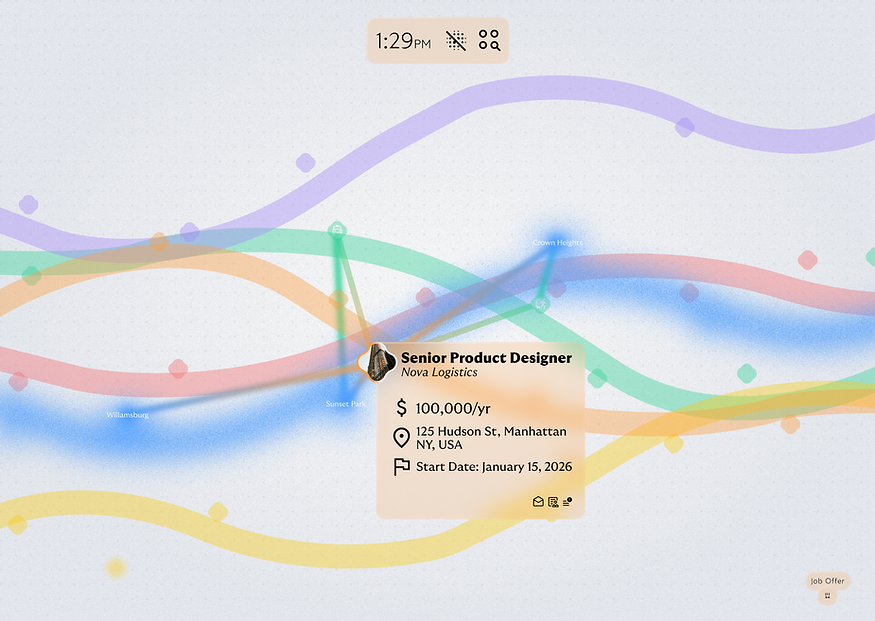
Part of Sequence 2: After selecting a specific node of a job, the Kesh highlights some nodes from a newly forming "thread" that it believes Pedro wants to explore next - like apartments and travel options
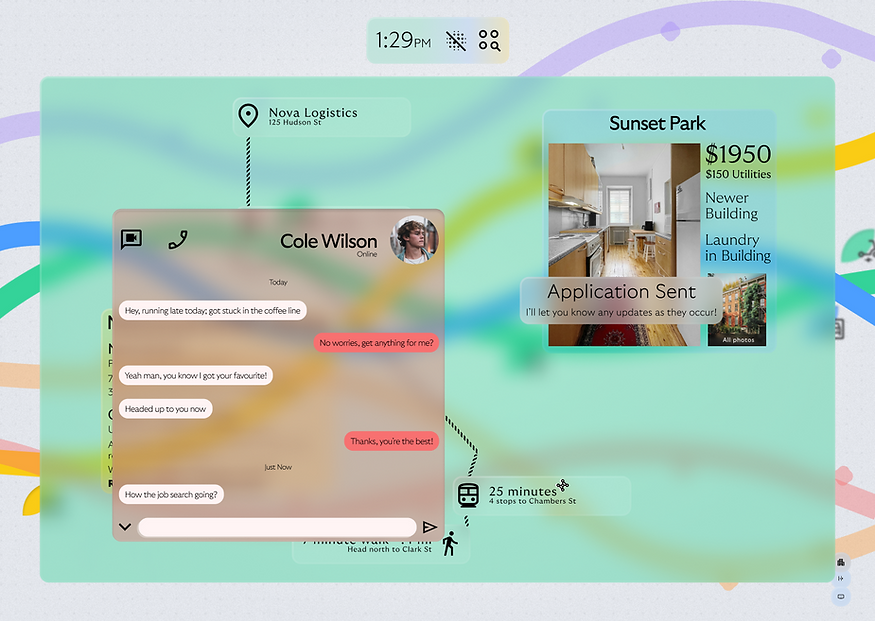
Part of Sequence 3: Multiple contexts (travel options, messages, apartment searching) converge together with the Kesh automating things like applications and travel expenses while allowing Pedro to still retain control

A personalized Mesh environment showing how core information structures remain stable as visual style and sensory conditions change.