
Thesis
AI Companion for Wealth Transfer UX
MASTER'S THESIS
Ambient Decision Support for Beauty Retail Employees
This thesis explores how real-time support systems can help beauty retail employees navigate complex client consultations without disrupting natural conversation. Through a series of research studies, the project investigates how ambient visualizations can surface relevant client history, product information, and areas of uncertainty to reduce cognitive load and support more confident recommendations.
Rather than replacing human expertise, the system enhances it by making relevant information visible at the moment decisions are being made.
FOCUS
UX Research
Interaction Design
Information Architecture
Human-AI Interaction
Prototyping
CHAIRS
DAVID OH
DEBORAH LITTLEJOHN
THE CHALLENGE
Beauty retail employees manage in-store consultations under time pressure, often relying on memory to recall product knowledge and prior client interactions. This can limit the depth and continuity of consultations, creating opportunities for design to support real-time access to contextually relevant information during live conversations.
THE INSIGHTS
Understand Before Disrupting
Designing beyond traditional system patterns first requires understanding why those patterns exist. New interactions are only successful when they preserve the core behaviors and expectations users already rely on.
Preserve Human Interaction
Technology should support, not compete with, human conversation. The most effective interventions remain in the background, enhancing interactions without drawing attention away from the people involved.
Support Without Replacing Judgment
Decision-support systems are most valuable when they guide rather than prescribe. By surfacing relevant information instead of providing answers, they help employees build confidence while maintaining ownership of their recommendations.
DESIGN DIRECTION
Drawing from Calm Technology and the research findings, the system was designed to provide support without interruption, keeping attention centered on the client rather than the interface.
Challenge Traditional Interface Patterns
Conventional interfaces often rely on explicit interaction and persistent controls. This system explores alternative approaches that prioritize awareness and guidance, enabling support without requiring users to shift attention away from the client.
Surface Only
What Matters
Information is filtered based on conversational context, reducing unnecessary complexity and preventing employees from sorting through large amounts of content during time-sensitive interactions.
Ambient by Design
The system communicates through subtle visuals that remain in the user's periphery. Information becomes visible when relevant and recedes when not, allowing for conversation-first interactions.
These principles guided how the system supports employees throughout live client interactions while remaining secondary to the conversation itself.
Design Explorations
The complete thesis document can be found here. It includes journey maps, task flows, and the conceptual framework used.
Study 1 | Ambient Relationship Recall
How can an ambient, non-verbal cue surface relevant client interaction history to support employee recall at the moment of re-entry, without disrupting in-person conversation?
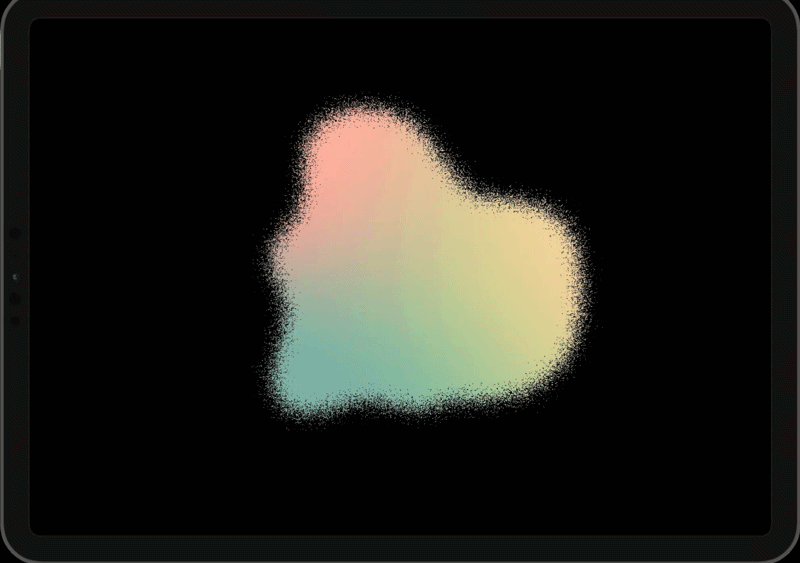
Resting state. A low-definition, slow-moving "blob" indicates no active interaction so it remains present but unobtrusive until a conversation begins.

Client recognition triggers a shift from resting. Key information (name, recent purchase, and core preferences) surface to reestablish continuity at the moment of re-entry.

Emerging inconsistencies between past and present inputs are highlighted as soft prompts so the employee can follow-up without prescribing action or disrupting conversational flow.
Resting state. A low-definition, slow-moving "blob" indicates no active interaction so it remains present but unobtrusive until a conversation begins.
The study revealed that recalling prior client interactions was most effective when information remained present but unobtrusive. Rather than displaying explicit histories or notifications, a continuously shifting visual form provided employees with awareness of client familiarity without interrupting conversation flow.
Study 2 | Real-Time Direction Signaling
How can real-time changes in visual emphasis signal the most relevant product directions during overlapping client interactions, helping employees move toward confident recommendations?

System forms around primary client's needs

Collapses when sensing an interruption

System collapses the finished client, bringing to center the secondary interaction.
System forms around primary client's needs
In order for more natural responses to occur; it was found that directional visual cues were easier to instinctively use in contrast to traditional recommendation interfaces. Visual noise alongside contextual tagging helped communicate recommendation paths while allowing employees to maintain ownership of the final decision.
Study 3 | Validation Feedback Signals
How can validation signals communicate areas of uncertainty in the employee’s understanding during a client interaction, helping guide targeted follow-up questions within a limited consultation window?

Early input is vague, so the system surfaces broad, low-confidence directions to highlight what is unclear rather than suggesting specific products.

As preferences become clearer, the system reduces somewhat in ambiguity, strengthening relevant paths and refining tags for follow-up.

With a high confidence level, the system can now surface a small set of aligned options giving autonomy while allowing the employee to move forward confidently.
Early input is vague, so the system surfaces broad, low-confidence directions to highlight what is unclear rather than suggesting specific products.
Direct "traditional" prompts often felt disruptive and incongruent to the system's purpose. It was found that translating uncertainty/ambiguity into lightweight cues encouraged employees to ask targeted follow-up questions while preserving the natural rhythm of a consultation.